|
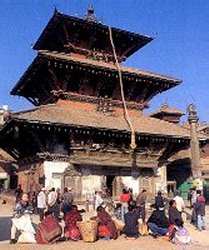 The ancient city is situated on the southern bank of the river Bagmati
and is about five kms southeast of Kathmandu. The city is full of Buddhist
monuments and Hindu temples with fine bronze gateways, guardian deities and
wonderful carvings. Noted for its craftsmen and metal workers, it is known as
the city of artists. Patan is the oldest of the three ancient city-kingdoms of the Kathmandu valley which once ruled by the mallas. Patan is still populated mostly by
Newars, two-thirds of them being Buddhist. As in Kathmandu and Bhaktapur, a fusion prevails between Hinduism
and Buddhism. Also, as in those cities, Patan has a Durbar Square and a labyrinth of winding lanes.
The square boasts of many famous sites and unique architecture. Krishna Mandir in the Patan Durbar Square
was built to honor an incarnation of Vishnu. Krishna fought by the side of the Pandavs in the
Mahabharat war to assure that truth would prevail. This temple is the best example of stone architecture in Nepal.
Scenes from the Mahabharat, Asia's greatest mythological war, are carved on the temple's wall.
The Bhimsen Temple which honors Bhim - great wrestler, brother of the Pandavs, and a deity to Nepalese businessmen -
contains fine samples of metal craft. The best place, however, to see metal sculpture is the
Hiranya Varna Mahabihar, the "Golden Temple". It is a Newar monastery which contains wall painting , fourteenth century
statues, and scriptures. Other sites including the Mahabouddha Temple and Uku Bahal are only a few minutes walk away from
the square. The streets in this area are home to metal sculptors of the present day. Many more temples dedicated
to Ganesh, the elephant-headed god, Shiva, Narsingha, Taleju, and others are situated in the Patan Durbar Square. The ancient city is situated on the southern bank of the river Bagmati
and is about five kms southeast of Kathmandu. The city is full of Buddhist
monuments and Hindu temples with fine bronze gateways, guardian deities and
wonderful carvings. Noted for its craftsmen and metal workers, it is known as
the city of artists. Patan is the oldest of the three ancient city-kingdoms of the Kathmandu valley which once ruled by the mallas. Patan is still populated mostly by
Newars, two-thirds of them being Buddhist. As in Kathmandu and Bhaktapur, a fusion prevails between Hinduism
and Buddhism. Also, as in those cities, Patan has a Durbar Square and a labyrinth of winding lanes.
The square boasts of many famous sites and unique architecture. Krishna Mandir in the Patan Durbar Square
was built to honor an incarnation of Vishnu. Krishna fought by the side of the Pandavs in the
Mahabharat war to assure that truth would prevail. This temple is the best example of stone architecture in Nepal.
Scenes from the Mahabharat, Asia's greatest mythological war, are carved on the temple's wall.
The Bhimsen Temple which honors Bhim - great wrestler, brother of the Pandavs, and a deity to Nepalese businessmen -
contains fine samples of metal craft. The best place, however, to see metal sculpture is the
Hiranya Varna Mahabihar, the "Golden Temple". It is a Newar monastery which contains wall painting , fourteenth century
statues, and scriptures. Other sites including the Mahabouddha Temple and Uku Bahal are only a few minutes walk away from
the square. The streets in this area are home to metal sculptors of the present day. Many more temples dedicated
to Ganesh, the elephant-headed god, Shiva, Narsingha, Taleju, and others are situated in the Patan Durbar Square. |
